THE PARIS NOTES
Genre: Literary Historical Fiction / Political Historical Fiction
A sweeping historical novel of revolution, empire, memory, and freedom, where private notes carry the dangerous power to awaken nations.
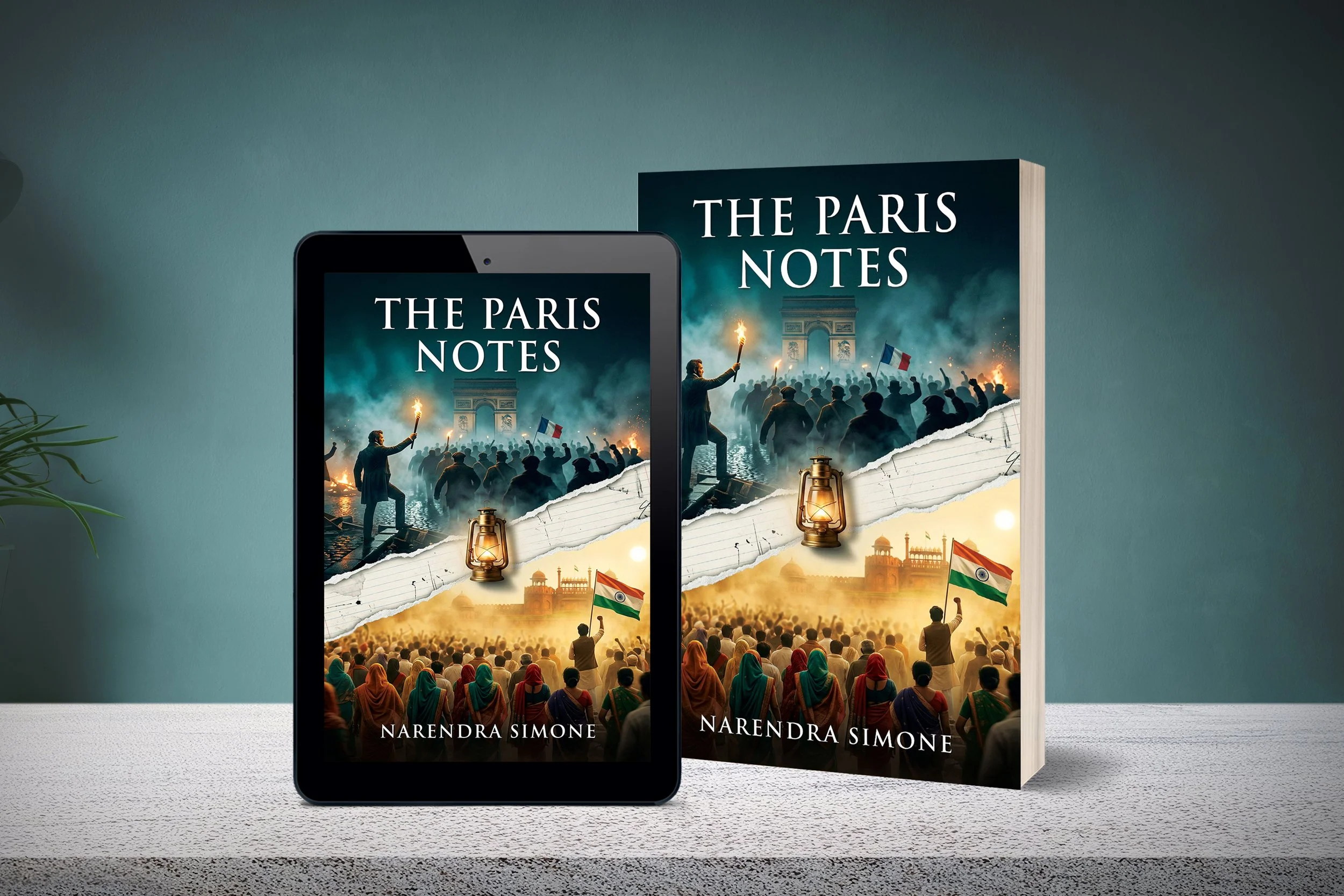
In Paris, 1848, the barricades fall—and a small red notebook survives. In its margins are dangerous ideas: rights, representation, limits on power. Smuggled across fogbound rivers and watched ports, THE PARIS NOTES begins as a relic of Europe’s failed revolutions… and becomes a fuse in a far larger empire.
A decade later, India is tightening under Company rule. In Calcutta, Lakshmi Rao translates the notebook’s principles into a language the streets can own. In Delhi, court insider Mirza Zafar fights to turn chaos into legitimacy. In the cantonments, sepoy Rafiq Ali learns to read—and discovers that paper can be more explosive than powder. And in the shadows, a British telegraph strategist and a smiling fixer hunt the one thing they fear most: a sentence that can’t be unlearned.
When a “Declaration” is printed with one line subtly altered, Delhi teeters between law and vengeance. Each choice becomes a turning point. Each betrayal rewrites the story. And as the uprising is crushed, the notebook’s true power is revealed: it doesn’t need to win in 1857 to shape what finally arrives in 1947.
A fast-paced historical thriller about ink, empire, and the long relay of freedom, THE PARIS NOTES asks: Who gets to write history—and what happens when the people start writing back?
Why I Wrote This Book
I wrote The Paris Notes because history does not move in straight lines. It travels through whispers, letters, revolutions, betrayals, unfinished dreams, and the courage of people who may never appear in official records.
The idea behind this book grew from a question that has long fascinated me: how do events in one part of the world awaken echoes in another? The revolutions of Europe, the unrest of empire, the struggle for freedom in India, and the long journey toward independence are often studied separately. Yet beneath them runs a shared human longing—the desire to be heard, to be free, and to reclaim dignity from the hands of power.
Paris, to me, became more than a city in this novel. It became a symbol: of ideas in motion, of dangerous hope, of private notes carrying public consequences. Through fiction, I wanted to explore how history enters individual lives—not as dates and declarations, but as fear, love, exile, loyalty, sacrifice, and moral choice.
I did not write this book simply to retell the past. I wrote it to ask what the past still asks of us. Freedom is never born in one country alone. It crosses borders, hides in memory, and survives through those brave enough to carry its unfinished song.
The Paris Notes is my tribute to that song.