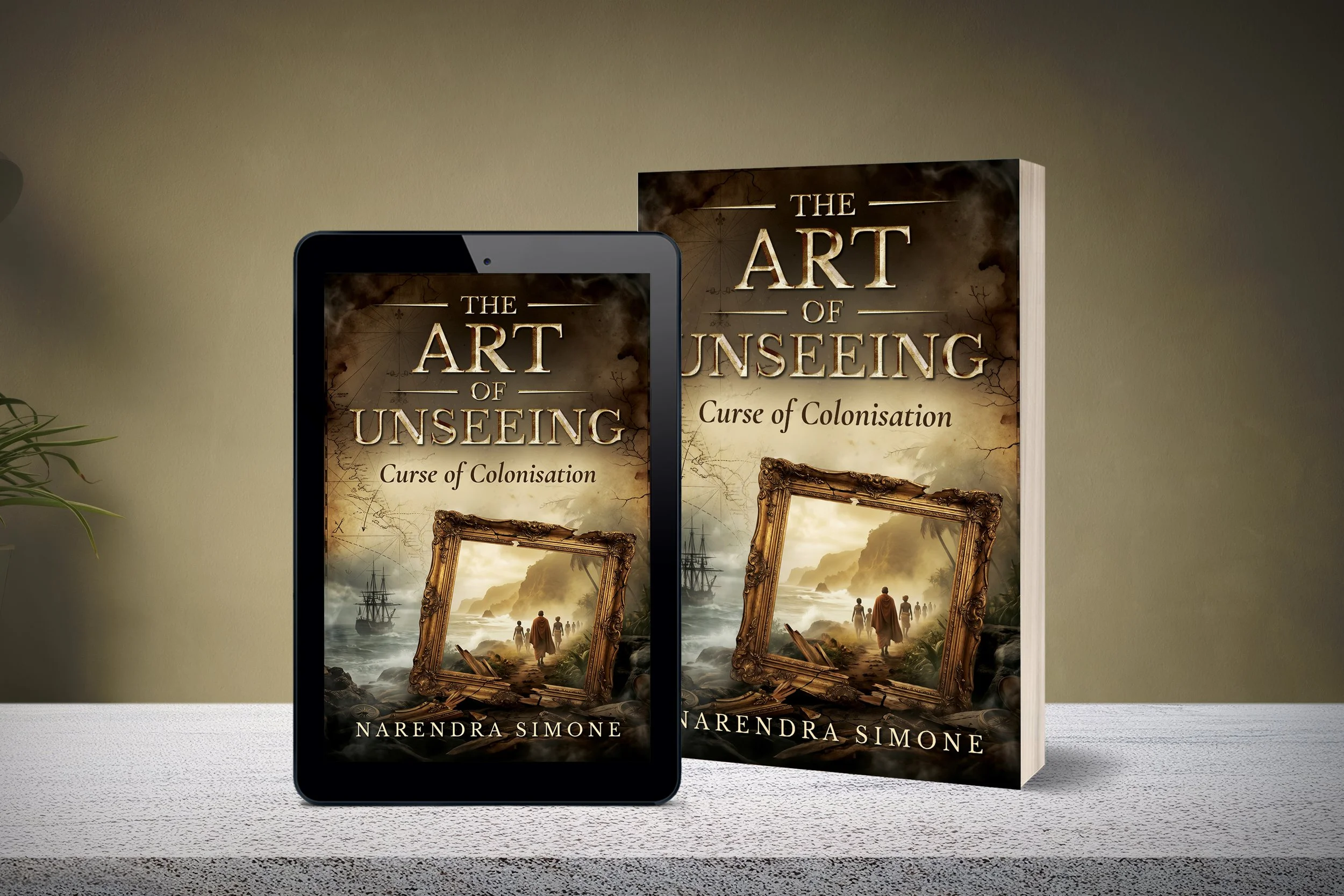
THE ART OF UNSEEING
The Curse of Colonisation
Genre: Literary Nonfiction — Postcolonial Art & Cultural Criticism.
A powerful journey through art, memory, and colonisation...
In THE ART OF UNSEEING — The Curse of Colonisation, Carol, a retired art critic and psychologist, and Rowen, a neuroscientist shaped by Eastern philosophy, return to their seaside condo in Sidney, overlooking the Salish Sea. Each morning, they sit beside the window and examine a painting that reveals, conceals, or challenges the moral wound of colonisation.
Their journey begins with Turner’s The Slave Ship, where the ocean itself becomes witness to profit without conscience. It moves through images of slavery, plantation cruelty, abolition, empire, treaty, progress, possession, settlement, removal, terror, and resistance. Paintings by François-Auguste Biard, Marcel Verdier, Benjamin West, John Gast, Albert Bierstadt, George Catlin, Gordon Bennett, Daniel Boyd, Kent Monkman, Wifredo Lam, Vasily Vereshchagin, and others become more than works of art. They become evidence. They become witnesses. They become mirrors held before civilisation.
But this is not a book about condemnation alone. It is a book about learning to see again.
Carol brings the trained eye of an art critic and the searching heart of a psychologist. Rowen deepens each painting through neuroscience and Eastern wisdom, showing how colonisation trained perception itself: how it made conquest look like discovery, theft like treaty, domination like protection, erasure like progress, and grief like nostalgia.
Together, they reveal that colonisation’s curse was not only the seizure of land, labour, children, language, dignity, and memory. It was the creation of a gaze—a way of looking that placed the coloniser at the centre and pushed whole peoples, histories, and living worlds beyond the frame.
To practise the art of unseeing is not to turn away. It is to unlearn the inherited blindness of empire. It is to see the shore instead of only the ship, the child instead of the policy, the land before the map, the person before the category, the living culture before the museum label.
Lyrical, philosophical, intimate, and morally urgent, THE ART OF UNSEEING invites readers to look at great paintings not as silent objects, but as portals into history’s hidden wounds—and into the harder, holier work of seeing truthfully.
Why I Wrote This Book
I wrote The Art of Unseeing because history is not only what is remembered; it is also what is carefully hidden, softened, renamed, or made invisible. Colonisation was not merely the movement of armies, flags, laws, and borders. It was also the shaping of memory, the training of the eye, the quiet instruction of generations to look at suffering without fully seeing it.
Art has always fascinated me because it can reveal what official histories often conceal. A painting may appear silent, yet within its colours, shadows, gestures, and absences, entire worlds are preserved. Behind beauty, there may be conquest. Behind elegance, dispossession. Behind the calm face of civilisation, a wound still asking to be acknowledged.
This book was written from that uneasy space between looking and truly seeing. It asks what happens when we return to images, histories, and inherited narratives with a more honest gaze. What did we fail to notice? What were we encouraged to admire? What human cost was hidden beneath the language of empire, progress, trade, and glory?
I did not write this book to accuse the past from the safety of the present. I wrote it to listen more carefully to the silences that remain. Colonisation did not end simply because empires changed their names or flags came down. Its afterlives continue in memory, poverty, identity, language, and the unequal ways in which humanity is still valued.
The Art of Unseeing is, therefore, an invitation: to look again, to question inherited comfort, and to recover the moral courage to see.
A powerful journey through art, memory, and colonisation, revealing the hidden truths history taught us not to see.